The Right Attic Insulation R-Value for Peachtree City
How Much Attic Insulation Does a Peachtree City Home Really Need?
Most Peachtree City homes need attic insulation somewhere between R-38 and R-60. With blown-in fiberglass, that works out to about 12 to 18 inches across the attic floor. A lot of the attics we climb into around town have half that, sometimes less. Homes built in the 1970s and 1980s usually started with R-11 to R-19, and forty years of settling, roof work and cable installs have only thinned it out further.
What Does R-Value Actually Measure?
R-value is a material's resistance to heat flow. A higher number means heat moves through more slowly, so less of that hot attic air reaches your bedroom ceiling in July. The numbers stack, too. If you have R-19 of old batts that are still dry and in decent shape, adding R-19 of blown-in on top gets you to R-38.
Depth is where people get confused. Six inches of closed-cell foam and twelve inches of blown fiberglass can land close to the same rating, so a ruler alone won't tell you much. On our attic insulation jobs, the depth we install depends entirely on the product going in.
Is R-38 Enough for a Georgia Attic?
Georgia falls in climate zone 3, and the Department of Energy puts the recommended attic range for this zone at R-30 to R-60. Current Georgia code asks for R-38 at the ceiling on new homes, so that's a fair minimum for an older house too. We usually suggest going to R-49 when bedrooms or a bonus room sit right under the roof.
Those rooms take the brunt of a July afternoon, when the attic above them can pass 130 degrees. Winter matters less here, but the same layer keeps furnace heat from drifting up.
Why Do Older Peachtree City Homes Come Up Short?
Most of the city went up between the 1970s and the 1990s, and builders back then usually stopped at R-11 to R-19. That alone puts plenty of homes under today's minimum.
Then add a few decades of normal life. Every roof repair, HVAC swap and cable run means someone crawling around up there, packing insulation down or shoving it aside. We find bare spots by the hatch and along the eaves all the time.
Old roof leaks leave insulation flat and stained, and mice love nesting in loose fill. When we find it in that shape, we do a full insulation removal and start clean, since fresh material over a mess won't hold its rating.
How Can You Check Your Own Attic?
Grab a flashlight and a tape measure. Once you're up there, look at the ceiling joists. Can you see the tops of them? Most joists are 7 to 9 inches tall, so if they're showing, you're almost certainly under R-30.
Push the tape down to the drywall in a few different places, not just next to the hatch where everything gets trampled. Check out toward the eaves as well, since that's where coverage usually thins. Anything under about 10 inches of loose fill deserves a closer look.
While you're up there, watch for damp or dark patches and any droppings. And stay on the joists. The drywall between them won't hold you.
Blown-In, Batts or Spray Foam?
For adding to an existing attic, we use blown-in attic insulation on most jobs. It goes down fast, fills in around wires and bracing, and reaches the odd corners that batts leave open.
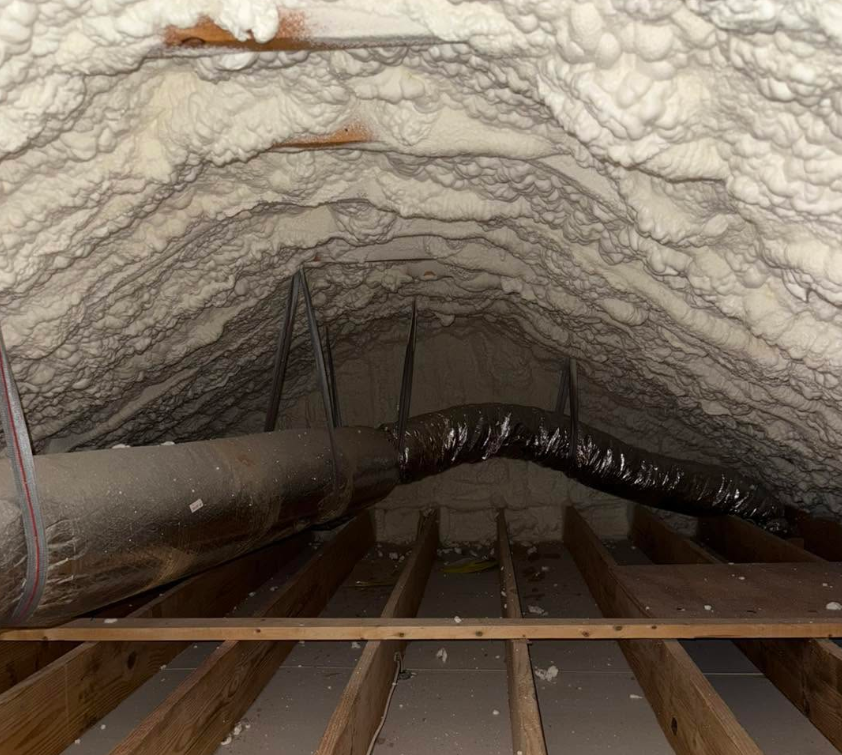
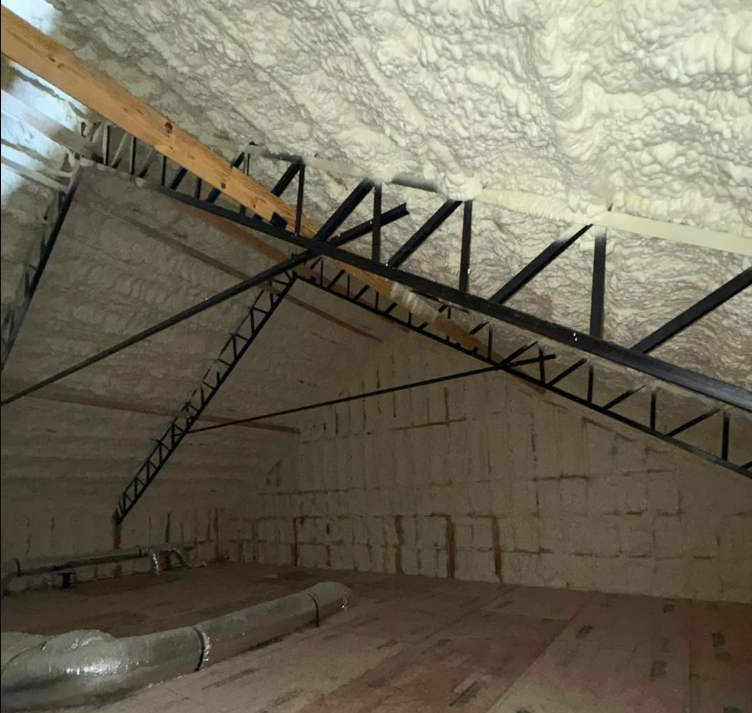
Batts are fine in a wide-open attic with standard joist spacing, but every gap around a pipe or junction box lets heat through. Closed-cell spray foam is a different kind of job altogether. It goes on the underside of the roof deck instead of the attic floor, which keeps the whole attic much closer to indoor temperature.
That pays off when your air handler and ductwork are up there baking all summer, though it costs quite a bit more.
What Does It Cost to Add Attic Insulation?
Topping up an attic with blown-in insulation in this part of Georgia usually costs around $1.00 to $2.50 per square foot. For an average Peachtree City house, that's often $1,500 to $4,000.
Where you fall in that range has a lot to do with how much is already up there and how high you want to go. If the old material has to come out first, add roughly $1.00 to $2.00 per square foot.
Closed-cell foam on the roof deck runs higher, commonly $2.50 to $5.00 per square foot or more. Tight attics, low roof pitches and crowded ductwork all push the price up. We can give you a real number once we've been up there with a tape.
Want Someone to Look at Your Attic?
We're Elite Coatings & Insulation, a family-run insulation company based in Senoia, a short drive from Peachtree City. We'll go up, measure what you have, check for moisture or pest damage, and tell you plainly whether you need a top-up, a full tear-out, or nothing at all.
If your upstairs always runs a few degrees warmer than the rest of the house, the attic is usually why. Book an attic inspection and we'll come take a look.
Frequently Asked Questions About Attic Insulation
How many inches of attic insulation do I need in Peachtree City?
With blown-in fiberglass, plan on roughly 12 to 18 inches to reach R-38 to R-60. Cellulose and spray foam get there with less depth, so the number depends on what is going in.
Can new insulation go right on top of the old stuff?
Usually, yes, as long as the old layer is dry and free of mold, pests and droppings. If it is wet, matted or contaminated, pull it out first.
Is R-38 enough in Georgia?
R-38 matches the code minimum for new homes in Georgia, so it is a reasonable floor. Rooms directly under the roof stay noticeably cooler at R-49.
Will more attic insulation lower my power bill?
In an under-insulated attic it usually does, mostly in summer when the AC is fighting attic heat. Sealing gaps around lights, vents and the hatch first helps even more.
How long does an attic insulation job take?
A blown-in top-up on an average home is often done in a few hours. Removal or spray foam work can take one to three days, depending on size and access.
